


SigmaPro Logo
+44 (0)1676 532470
Twitter Facebook LinkedIn
sigmapro.uk@sigmapro.com Mail
GLOBAL Global Icon
Subscribe via RSS
  • Home
  • About Us
    • Values
    • People
    • Why SigmaPro?
    • Worldwide
    • Privacy Policy
  • Consulting
    • Business Improvement
      • Competences
      • Maturity Assessment
      • Approach
      • Case Studies
    • Solving Problems
    • Managing Change
    • Coaching & Support
    • Growth
  • Training
    • Executive Training
    • Management Training
    • Practitioner Training
    • Operational (Awareness) Training
  • Resources
    • Lean Six Sigma
    • Articles
    • Research
    • Software
      • Minitab Software
      • Sigma Work Software
      • Riskwizard Software
      • Processmodel
    • Publications
    • Links
    • FAQ's
    • HR Professionals
  • Contact Us
  • Blog
  • Problem solving & change management, tailored solutions delivered fast
  • Bright Ideas: train your team to come up with the future
  • Invest in yourself: study with qualified Lean Six Sigma experts

  SigmaPro Guide


SigmaPro Guide IconDownload Your FREE SigmaPro Guide to Lean Six Sigma NOW!


Subscribe to blog Subscribe via RSS

SigmaPro Blog

SigmaPro is a leading global provider of Lean Six Sigma Training, Lean Six Sigma consulting and business improvement programmes designed to help organisations achieve breakthrough performance improvement.

  • Home
    Home This is where you can find all the blog posts throughout the site.
  • Categories
    Categories Displays a list of categories from this blog.
  • Tags
    Tags Displays a list of tags that have been used in the blog.
  • Bloggers
    Bloggers Search for your favorite blogger from this site.
  • Team Blogs
    Team Blogs Find your favorite team blogs here.
  • Login
    Login Login form
Chris Rees

Chris Rees

Chris Rees has not set their biography yet

  • Subscribe to updates from author
  • Subscribe via RSS
Chris Rees

HOW MANY PEOPLE WILL DIE IN THE UK FROM CORONAVIRUS?

Posted by Chris Rees on Monday, 06 April 2020 in Uncategorized

HOW MANY PEOPLE WILL DIE IN THE UK FROM CORONAVIRUS?

Firstly, this article is my own view and not representative of SigmaPro as a whole. Secondly it is not intended in any way to trivialise the fact that so far, over 66,000 people have lost their lives as a result of Coronavirus across the World. To lose a loved one under any circumstances is a terrible thing, especially when one feels that it could have been prevented, and our thoughts and prayers go out to anyone that has been affected directly or indirectly by coronavirus.

...
0 Comments Continue reading
Hits: 3365
0
Chris Rees

Process Capability

Posted by Chris Rees on Thursday, 11 August 2016 in Lean Six Sigma


In a previous blog, I have covered process stability, which is the first part of assessing the current (or baseline) performance of the process, typically involving control charts. The biggest mistake people make when examining process stability using control charts is to confuse control limits and specification limits. Specification limits have nothing to do with statistical control, and control limits have nothing to do with specification limits!

The measure that relates process performance to specification is process capability.

...
0 Comments Continue reading
Hits: 6482
0
Chris Rees

Failure Modes and Effects Analysis

Posted by Chris Rees on Wednesday, 04 May 2016 in Lean Six Sigma

The first phase of the Control stage in DMAIC is to develop a control plan. A control plan is a document that records how all significant process characteristics will be kept in line with the defined requirements. Before a control plan can be developed however, the improvement leader will need to consider what could go wrong with the process, as the controls need to be designed to detect this.

In this article we will look at a technique called FMEA (Failure Modes and Effects Analysis, and how it can be used to identify and reduce risk. Although an FMEA is typically used in the Control phase, it can also be used in Improve, or indeed in any phase where a structured approach to risk identification is required.

...
0 Comments Continue reading
Hits: 6355
0
Chris Rees

A Four Phase Approach to Change & Transformation

Posted by Chris Rees on Thursday, 17 March 2016 in Lean Six Sigma

In a previous article we concluded that implementing strategy means changing the organisation, so any structured improvement approach that works involves changing the organisation. We also concluded that if we recognise that improvement requires change, and we want to achieve sustainable, ongoing improvement, then we cannot purely consider change as a process with a start and end point, we need to consider change as a cycle.

This article will consider the importance of linking improvement approach to organisation strategy and propose a four step cyclical approach to ongoing change to make it a part of sustainable improvement.

...
0 Comments Continue reading
Hits: 7504
0
Chris Rees

Approaches to Change & Transformation

Posted by Chris Rees on Thursday, 25 February 2016 in Lean Six Sigma

If you are thinking of introducing Lean, Six Sigma or for that matter any other kind of sustainable improvement approach into your organisation, you will need to consider how you manage change. You will also need to consider how the proposed changes will support organisation strategy – and if you are thinking “there is no need to consider how it supports strategy, that’s something separate” then sorry that’s wrong thinking!”

Both Lean and Six Sigma originated as strategic enablers. Lean originated with Taiichi Ohno in Toyota, Toyota’s need was to be able to compete with the American automobile industry, which was dominating globally in the 1950’s using volume production. The Japanese strategy was to compete by offering different models with different options, but this required a change in manufacturing capability, to be able to produce faster, with lower stock and higher variety.

...
0 Comments Continue reading
Hits: 5573
0
Chris Rees

Graphical Methods Overview

Posted by Chris Rees on Wednesday, 10 February 2016 in Lean Six Sigma

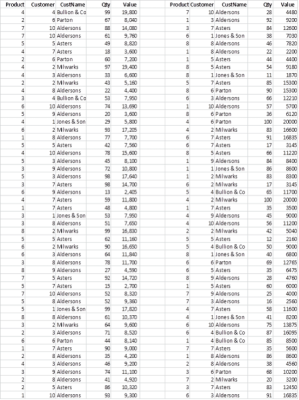
They say that a picture paints a thousand words, consider the columns of data below which show revenue by product and customer for the last 3 months. How easy is it to see which customer gives the most revenue?

b2ap3_thumbnail_GMO1.png

...
0 Comments Continue reading
Hits: 5950
0
Chris Rees

Hypothesis Testing

Posted by Chris Rees on Friday, 22 January 2016 in Lean Six Sigma

A hypothesis test is a statistical test that is used to determine whether there is enough evidence in a sample of data to infer that a certain condition is true for the entire population. Hypothesis testing involves defining two mutually exclusive statements, and then using sample data to determine which statement is best supported by the facts. These two statements are called the null hypothesis and the alternative hypotheses. They are always statements about population attributes, such as the value of a parameter, the difference between corresponding parameters of multiple populations, or the type of distribution that best describes the population.

Hypothesis testing gives answers to practical questions such as:

...
0 Comments Continue reading
Hits: 5862
0
Chris Rees

Confidence Intervals

Posted by Chris Rees on Sunday, 20 December 2015 in Lean Six Sigma

In most projects, most of the time we are taking samples and using inferential statistics to infer population parameters. Why? Because to take the whole population would be impractical, too costly or too time consuming. This of course means that there is a risk that our parameters do not represent the whole population. The question this raises is how big is the risk, or expressed another way, what real confidence do we have in the parameters we have calculated being representative of the whole population?

For example, we want to find the average height of men aged 40 in the United Kingdom, so we take a sample of 50 people at random and work out the mean and standard deviation. How likely is it that our calculated parameters are the same as the whole population? If they are not then how close are they likely to be?

...
0 Comments Continue reading
Hits: 6292
0
Chris Rees

Interrogation of the Value Stream

Posted by Chris Rees on Monday, 24 August 2015 in Lean Six Sigma

In the article on 29 January 2015, we discussed Value Stream Mapping as a particular approach to understanding the Value Stream that ensures customer value is created using a high level process mapping approach. The article was about the first phase of Value Stream Mapping, creating an existing map.

As a reminder, Value Stream Mapping is a lean approach to improving the Value Stream, and as such has 4 main stages:

...
0 Comments Continue reading
Hits: 6081
0
Chris Rees

Process Stability

Posted by Chris Rees on Monday, 03 August 2015 in Lean Six Sigma

If we consider any process, it could be the machining of a shaft
diameter or the time taken to answer the phone in a call centre, we know
it will vary. If we collect data over time there will be an average
diameter or answering time and the individual values will be dispersed
around the average.

f we know nothing about statistics and variation, then we may try to
adjust the machine or do something about call answering times each time
we see a value either above or below the average. But what about if the
diameter is too low and we adjust it upward but the next value would
have been higher anyway? Adjusting the process in this way just makes
performance worse, it is technically known as over adjustment.

...
0 Comments Continue reading
Hits: 5743
0
Chris Rees

Process Mapping

Posted by Chris Rees on Tuesday, 02 June 2015 in Lean Six Sigma

Process Mapping is a fundamental component of either waste elimination or variability reduction. Process mapping enables the improvement team to get an understanding of the existing process, to help identify sources of waste and variability. It is the first milestone in the Measure phase, describing the process.

Wikipedia defines states: “Business process mapping refers to activities involved in defining what a business entity does, who is responsible, to what standard the process should be completed, and how the success of the process can be determined. The main purpose behind business process mapping is to assist organizations in becoming more efficient”. We would add to that “or more effective”.

...
0 Comments Continue reading
Hits: 6203
0
Chris Rees

Data Accuracy

Posted by Chris Rees on Friday, 27 March 2015 in Lean Six Sigma

Most people when they collect data will not question the accuracy of the data, but there is always the possibility that the data is NOT accurate! Inaccurate data is in some ways worse than no data, because at least you know when you have no data, but when making decisions with inaccurate data you may not even know it so there is a high risk the wrong decisions will be made.

Consider the diagram below. If you measure a component and find the result is just inside the tolerance limit, do you accept or reject the component? This could be a product with a tolerance, or a service feature. Most people would accept it.

...
0 Comments Continue reading
Hits: 6856
0
Chris Rees

Understanding Basic Statistics

Posted by Chris Rees on Thursday, 05 March 2015 in Lean Six Sigma

Why Statistics?

When we run an improvement project, we will be collecting data. Take as an example a project to reduce scrap on an assembly line, or a project to improve throughput time on processing an insurance claim. In both cases we will have questions such as which are the biggest problems, what is the current performance of the process, how variable is it? We must collect and use data to answer these questions. Once collected, turning data into meaningful information is essential to our project.

...
0 Comments Continue reading
Hits: 169665
0
Chris Rees

Deciding what Data to Collect for your Project

Posted by Chris Rees on Thursday, 19 February 2015 in Lean Six Sigma

Lean Six Sigma is a data driven decision making approach. Most people are confident in mapping a process, the next question then is what data could I collect, and how should I decide which data is most important? One of the biggest mistakes that new process improvement leaders make is to try and collect too much data!

This article will illustrate a four step process to decide what data to collect and describe some simple tools to aid that process.

...
0 Comments Continue reading
Hits: 7857
0
Chris Rees

8 Steps to Build a Value Stream Map

Posted by Chris Rees on Thursday, 29 January 2015 in Lean Six Sigma

Value Stream Mapping (VSM for short) is a term heard more and more frequently these days, particularly in business improvement. Those who have been involved in business improvement for a while however will be able to tell stories about seeing magnificent maps with multiple steps, a rainbow of coloured notes and a huge amount of data, created enthusiastically and displayed with pride by their creators. When asked what has been done as a result of all the work to improve the organisation, the answer sadly is little or nothing.

So what is VSM, why the interest in it, and why the apparent problems with little work being done as a result of the activity?

...
0 Comments Continue reading
Hits: 6898
0
Chris Rees

A Five Step Approach to Managing Stakeholders

Posted by Chris Rees on Monday, 12 January 2015 in Lean Six Sigma

In the previous article we advised improvement project leaders to have a structured approach to five key elements when managing change in projects:

  • Focus on the “A” side of the Q x A = E equation
  • Establish clear goals and objectives
  • Provide Leadership
  • Manage resistance
  • Communicate, communicate, communicate

Focusing on the A side of the Q x A = E equation means improvement project leaders should spend time on ensuring cultural acceptance and not just time on technical tools and data. Master Black Belts should spend 50% of their time on the A side of the equation. Probably Black Belts should spend at least 30% of their time on A, and Green Belts 20%. This will vary depending on the challenges faced of course but it gives an idea of how significant a commitment is required.

...
0 Comments Continue reading
Hits: 6509
0
Chris Rees

5 Key Elements of Managing Change in Improvement Projects

Posted by Chris Rees on Friday, 19 December 2014 in Lean Six Sigma

In Lean Six Sigma, or any improvement activity, there will always be change, because without change things stay the same, and if they stay the same, there cannot be improvement. So in any effort or project to improve things, managing change will always be a part of the process.

Knowledge of technical tools will therefore not be enough to ensure a successful project; knowledge of change management tools will also be required.

...
0 Comments Continue reading
Hits: 6581
0
Chris Rees

Reviewing the Business Case for Lean Six Sigma

Posted by Chris Rees on Wednesday, 10 December 2014 in Lean Six Sigma

SigmaPro uses a five phase approach to developing a sustainable approach to performance improvement.

Five Phase Approach to Performance Improvement

...
0 Comments Continue reading
Hits: 6733
0
Chris Rees

Deployment Planning - 6 Key Areas to Consider

Posted by Chris Rees on Wednesday, 03 December 2014 in Lean Six Sigma

“Our plans miscarry because they have no aim.  When a man does not know what harbour he is making for, no wind is the right wind.” Seneca (4BC – AD65)

Many people have heard of Lean, Six Sigma and Lean Six Sigma. Perhaps fewer have actually worked with Lean Six Sigma methods and tools such as DMAIC and DMADV, worked to identify and eliminate leans 7 wastes. Even fewer will have achieved some fantastic project successes for their organisations, and a small number of the above will have become certified Green, Black or Master Black Belts.

...
0 Comments Continue reading
Hits: 6376
0
Chris Rees

Data Driven Decision Making

Posted by Chris Rees on Thursday, 20 November 2014 in Lean Six Sigma

At Sigma we have studied many organisations that have achieved success, and identified four organisational competences that are required to achieve a sustainable approach to business improvement. These are Strategic Thinking, Operational Excellence, Data Driven Decision Making and Continual & Breakthrough Improvement. Supported by the right kind of culture, values and leadership, an organisation can achieve sustainable improvement.

b2ap3_thumbnail_DDD1.png

...
0 Comments Continue reading
Hits: 6916
0
  • Page :
  • 1
  • 2
  • Next

Request Further Info


  1. Name(*)
    Please let us know your name.
  2. Email Address(*)
    Please let us know your email address.
  3. Phone Number(*)
    Please enter your phone number
  4. Company Name
    Invalid Input
  5. Message
    Please let us know your message.
  6. Please Contact Me By(*)

    Please select a contact preference
  7. Invalid Input
  8. Invalid Input
  9. What is 10 + 2 = ?(*)
    Invalid Input

Address Details


SigmaPro Ltd

Merrydale House, Roydsdale Way,
Bradford, BD4 6SE

T: +44 (0)1676 532470
F: +44 (0)1676 534544
E: sigmapro.uk@sigmapro.com

Quick Links


About Us
Consulting
Training
Calendar
Contact
Global
Resources
Sitemap
Privacy Policy

Courses


Online Lean Intro SIX Sigma
Lean Six Sigma Intro
Lean Six Sigma Champion
Lean Six Sigma Green Belt
Lean Six Sigma Black Belt
Lean Six Sigma BB Upgrade
Lean Six Sigma MBB
Lean Practitioner